
EXOMIND in Gainesville at Davis Integrative Medicine.
Your mental well-being belongs in the conversation about your health. EXOMIND offers noninvasive magnetic stimulation for specific mental-health conditions, with no surgery or anesthesia. Explore how it may fit alongside your existing care through an assessment that considers your history, treatment experience and goals.
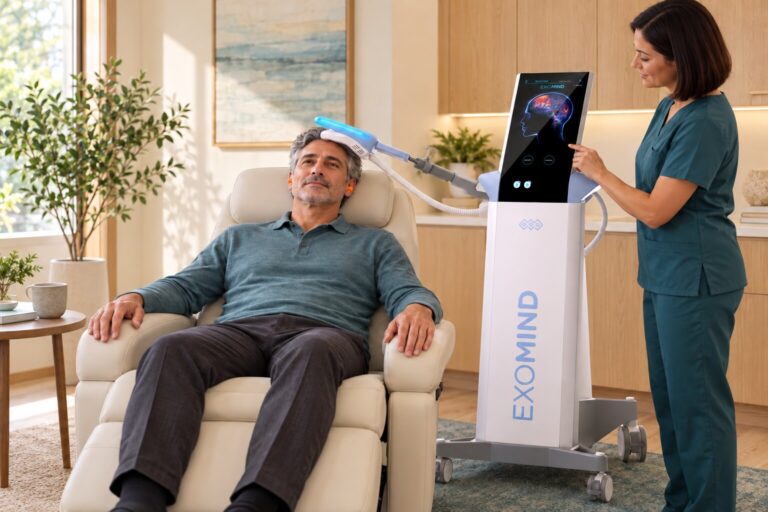
Transcranial magnetic stimulation, or TMS, uses an external coil to deliver magnetic pulses to selected brain regions. EXOMIND is a prescription TMS platform used in depression care. Treatment does not involve surgery or general anesthesia, and you remain awake during a session.
For suitable patients, TMS may reduce depressive symptoms. It does not work for everyone, and the size and timing of any improvement vary. Choosing treatment means considering the evidence, your health history, the proposed course, and the other options available to you.
The EXOMIND platform has FDA clearance for adults with major depressive disorder: treatment of depressive episodes and reduction of accompanying anxiety symptoms when prior antidepressant medication has not provided satisfactory improvement during the current episode; adults with obsessive-compulsive disorder as an adjunct, meaning alongside other care; and patients ages 15–21 with major depressive disorder as an adjunct to existing care.
A clinical assessment determines whether treatment is appropriate. The indications and protocols available at this practice depend on its equipment configuration and clinical services.
EXOMIND may be an option for adults with major depressive disorder whose current episode has not improved satisfactorily with antidepressant medication. Your clinician must establish whether the treatment is appropriate for your individual circumstances.
A thorough assessment should cover:
Bring your questions and a current medication list to your clinical appointment. Keep taking prescribed medication and attending existing care unless your treating clinician recommends a change.
The decision to use EXOMIND belongs within a broader conversation about your health. Ask how progress will be assessed, who to contact between visits, and how follow-up will be handled. If you already work with a psychiatrist, therapist, or another treating clinician, discuss how to coordinate care.
An initial assessment is also a chance to understand the practical commitment. Appointment length and the number and spacing of sessions depend on the prescribed protocol. There is no single schedule that should be assumed for every patient.
After screening and appropriate setup, an applicator is positioned against your head. The team determines the treatment location and stimulation settings. Hearing protection is used, and you should be monitored throughout the session.
The device makes clicking sounds. You may feel tapping, twitching, or discomfort near the treatment area. Let the team know how you feel. Ask your clinician what to expect afterward and whether any symptoms or other treatments affect your plans for the day.
Possible side effects include headache, scalp discomfort, muscle contractions around the face or jaw, and dizziness or lightheadedness. A seizure is an uncommon but serious potential risk. Hearing protection is important because of the noise produced during stimulation.
Some metal or electronic implants can interfere with safe treatment, particularly when located near the head. A history of seizures, neurological conditions, and medications that affect seizure risk all need careful review. The current safety instructions for the specific device must guide screening.
This page cannot cover every risk or contraindication. Request the patient safety information and discuss any concerns before consenting to treatment. Notify your treating clinician promptly if depression worsens or other concerning symptoms develop.
The BTL-699 EXOMIND platform is FDA-cleared for specific patient groups and indications. Adult major depressive disorder is included when prior antidepressant treatment has not produced satisfactory improvement during the current episode. Clearance does not establish that an individual is a suitable candidate or guarantee a result. View the FDA clearance summary.
Do not stop or change your care on your own. Your treating clinician should review any proposed changes and explain how EXOMIND fits into your treatment plan.
Discuss each treatment with your clinician. Combining therapies requires an individual assessment of safety, timing, and evidence; booking one service does not establish that a combination is appropriate.
Ask how your symptoms will be assessed before, during, and after treatment. Your clinician can explain realistic expectations and what the next steps would be if your response is limited.
Request the consultation fee, the cost of the proposed treatment course, and any follow-up charges. Confirm payment arrangements and cancellation terms before committing.
Contact our Gainesville office to ask about EXOMIND assessment availability. A clinical consultation can help you understand whether this approach is worth considering for your depression care.
322 SW 4th Ave, Gainesville, FL 32601.
Use website inquiries for scheduling questions. Ask the office for the appropriate intake process before sending medical records or a detailed health history.
For emergency medical care, call 911 or go to the nearest emergency department. Do not wait for a website inquiry response.
Further reading: NIMH overview of TMS · BTL’s EXOMIND information.
Davis Integrative Medicine
322 SW 4th Ave, Gainesville, FL 32601
We are a Gainesville functional medicine clinic, offering holistic care including hormone therapy for men and women, bioidentical hormones, ketamine infusions, IV therapy and more. Blog.
Services
Location